One of my leisure time activities is to develop KMyMoney, a personal finance management application. Most of my time is spent on development, testing, bug reproduction and fixing, user support and sometimes I even write some documentation for this application. And of course, I use it myself on a more or less daily basis.
One of the nice KMyMoney features that helps me a lot is the online transaction download. It’s cool, if you simply fire up your computer in the morning, start KMyMoney, select the “Account/Update all” function, fill in the passwords to your bank and Paypal accounts when asked (though also that is mostly automated using a local GPG protected password store) and see the data coming in. After about a minute I have an overview what happened in the last 24 hours on my accounts. No paper statement needed, so one could say, heavily digitalized. At this point, many thanks go out to the author of AqBanking which does all the heavy work dealing with bank’s protocols under the hood. But a picture is worth a thousand words. See for yourself how this looks like:
A recording of my daily download procedure
The process is working for a long time and I have not touched any of the software parts lately. Today, I noticed a strange thing happening because one of my accounts showed me a difference between the account balance on file and the amount provided by the bank after a download. This may happen, if you enter transactions manually but since I only download them from the bank, there should not be any difference at all. Plus, today is Sunday while on the day before everything was just fine. First thought: which corner case did I hit that KMyMoney is behaving this way and where is the bug?
First thing I usually do in this case is to just close the application and start afresh. No way: same result. Then I remembered, that I added a feature the day before to the QIF importer which also included a small change in the general statement reader code. Of course, I tested things with the QIF importer but not with AqBanking. Maybe, some error creeped into the code and causes this problem. I double checked the code and since it dealt with tags – which are certainly not provided by my bank – it could not be the cause of it.
So I looked at the screen again:
The ledger on the left shows the state before and the one on the right after the download.
New data must have been received because the date in the left column changed and also the amount of the colored row changed but not the one in the row above which still shows the previous state. The color is determined by comparing the balance information with the one in the row above. So where is/where are the missing transaction(s)?
Long story short: looking at the logs I noticed, that the online balance was transmitted but there was no transaction at all submitted by the bank. And if I simply take the difference between the two balances it comes down to a reimbursement payment which I expect to receive.
Conclusion: no bug in KMyMoney, but the bank simply provided inconsistent data. Arrrrgh.
You might have seen the awesome Klassy theme by Paul McAuley for Qt
applications and window decorations for KWin.
Klassy
It has some issues compiling against the latest Plasma since the
KDecoration API break.
Until it is fixed in the main repository, I’ve created a temporary
fork that includes the port to KDecoration3 done by Eliza Mason, with a
tiny additional fix I added on top of it. The fork is available at github.com/ivan-cukic/wip-klassy
Kirigami Addons is a collection of additional components for Kirigami
applications. 1.7.0 is a relatively big release bringing a new convergent
component for context menus as well as various quality of life APIs to existing
components.
ConvergentContextMenu
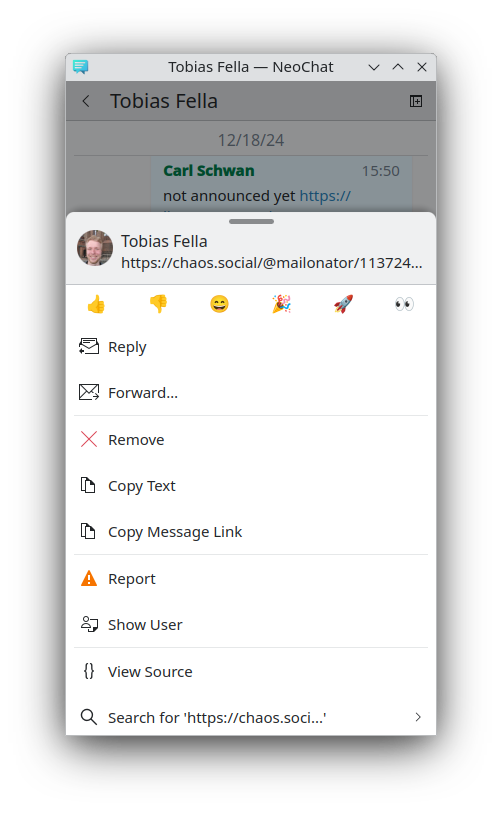
This release bring a new component which wraps the tradional context menu
Controls.Menu provided by Qt and on mobile will instead displays a BottomDrawer
with the list of actions.
Using it, is really easy:
importQtQuick.ControlsasControlsimportorg.kde.kirigamiasKirigamiimportorg.kde.kirigamiaddons.componentsasComponentsimportorg.kde.kirigamiaddons.formcardasFormCardComponents.ConvergentContextMenu{id: root// Only visible on mobile to show a bit of information about the selected element
headerContentItem:RowLayout{spacing:Kirigami.Units.smallSpacingKirigami.Avatar{...}Kirigami.Heading{level:2text:"Room Name"}}Controls.Action{text:i18nc("@action:inmenu","Simple Action")}Kirigami.Action{text:i18nc("@action:inmenu","Nested Action")Controls.Action{...}Controls.Action{...}Controls.Action{...}}Kirigami.Action{text:i18nc("@action:inmenu","Nested Action with Multiple Choices")Kirigami.Action{text:i18nc("@action:inmenu","Follow Global Settings")checkable:trueautoExclusive:true// Since KF 6.10
}Kirigami.Action{text:i18nc("@action:inmenu","Enabled")checkable:trueautoExclusive:true// Since KF 6.10
}Kirigami.Action{text:i18nc("@action:inmenu","Disabled")checkable:trueautoExclusive:true// Since KF 6.10
}}// custom FormCard delegate only supported on mobile
Kirigami.Action{visible:Kirigami.Settings.isMobiledisplayComponent:FormCard.FormButtonDelegate{...}}}
Icons on Android
Kirigami Addons components are using some breeze icons which needs to be packaged
manually on android by calling kirigami_package_breeze_icons with the icons used.
Now Kirigami Addons, provides a Cmake variable KIRIGAMI_ADDONS_ICONS listing all
the icons used by Kirigami Addons, simplifying the maintainance work of applications
to keep the list of icons used up-to-date.
The FormCardPage now uses a slighly less grey to get more contrasts with the sidebar.
We cleaned up FormComboBoxDelegate to not relly on the applicationWindow()
hack from Kirigami anymore. This fixes using FormComboBoxDelegate in Plasma
Settings. Unfortunately some areas of Kirigami Addons still implicitely rely on
applicationWindow() to set the parent of popups (Kirigami has a similar
issue). If you are using dialogs or popup in your code, make sure to
explicitely pass a valid Controls.Overlay.overlay as parent to them instead
of rellying on applicationWindow() being valid all the time.
The FormCard.AboutPage now show the KDE Frameworks version in use rather than
the one we built against. We are also using in the AboutKDEPage component,
the same bug address as in the AboutPage component. And we fixed various other small
issues with the about pages. Thanks Volker and Joshua!
Other
We now use clang-format automatically and various clang-tidy warnings were fixed. Thanks Alex!
Avatar are now loaded asynchronously which should make NeoChat, Tokodon and Merkuro list views smoother. Thank Kai! Addionally the text fallback is now only rendered as plain text, which should also be sligly faster.
The RadioSelector now uses the style from Marknote.
We updated the templates provided by Kirigami Addons to the latest version of the flatpak
runtimes and some other minor improvements like using the new KLocalizedQmlContext.
AlbumMaximizeComponent now expose not only the currentItem from the internal
view, but also the currentIndex.
The IndicatorItemDelegate and RoundedItemDelegate components are now easier to
use with drag and drop interaction. You can see that in effect in last week update
of Merkuro Mail.
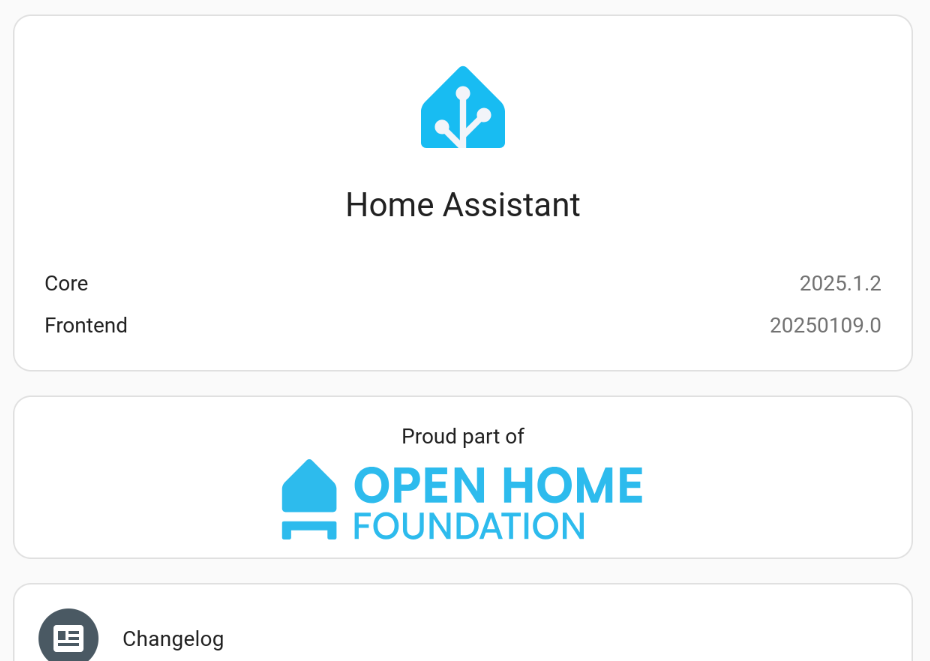
I run Home Assistant Core on a Raspberry Pi. I installed it in a Python venv and now and then I feel a need to upgrade. Today was such a day.
So, having backed everything up, I went for the plunge. Let’s install version 2025.1.2.
The usual dance goes a bit like this:
sudo systemctl stop homeassistant
sudo su homeassistant
cd /opt/homeassistant
source bin/activate
pip install --upgrade homeassistant
exit
sudo systemctl start homeassistant
Then all the dependencies are installed, so I usually go for a coffee, and once things have settled down (I use top to check that the system is idle), I usually restart homeassistance, just to make sure that it stops and starts nicely.
This time, I had no such luck. Lots of little issues. The major one seemed to be that import av in one of the core modules suffered from some sort of ValueError exception.
Having duckducked the issue for a while, I realized this meant that I had to do the upgrade from Python 3.12 to 3.13. Upgrading va to version 14.x using pip does not help. Since I always forget how to do this, I’m now writing this blog post.
Recollecting the steps, the moves are, more or less these:
Again, restarting Home Assistant takes a while and a bit more since all the dependencies are built. Go grab a snack or just a quiet coffee and, viola, you will end up with a fresh install of Home Assistant version 2025.1.2
If you’re old enough, you probably remember that there was a meme
from the 4.x days is that Plasma is all about clocks.
I’ve started working on some new artwork, and ended up sidetracked
spending more time designing fun clocks for Plasma than on what I
planned to work on, proving there’s some truth to the meme.
These are based on one of the coolest watch designs I’ve seen in
recent years – a Raketa Avant Garde:
In the latest Plasma 6.3 Beta, you will find a new executable named kcursorgen in /usr/bin. It can convert an SVG cursor theme to the XCursor format, in any sizes you like. Although this tool is intended for internal use in future Plasma versions, there are a few tricks you can play now with it and an SVG cursor theme.
(Unfortunately, the only theme with the support that I know, besides Breeze, is Catppuccin. I have this little script that might help you convert more cursor themes.)
Requirements
The qt6-svg library.
The xcursorgen command, usually found in xorg-xcursorgen package.
Trick 1: Cursors at any size you like
You should be able to set any cursor size with SVG cursors, right? Well, not at the moment, because:
Only those apps using the Wayland cursor shape protocol would be using SVG cursors. Other apps still use the XCursor format, with a limited list of sizes.
Plasma's cursor setting UI hasn't been updated to allow arbitrary sizes.
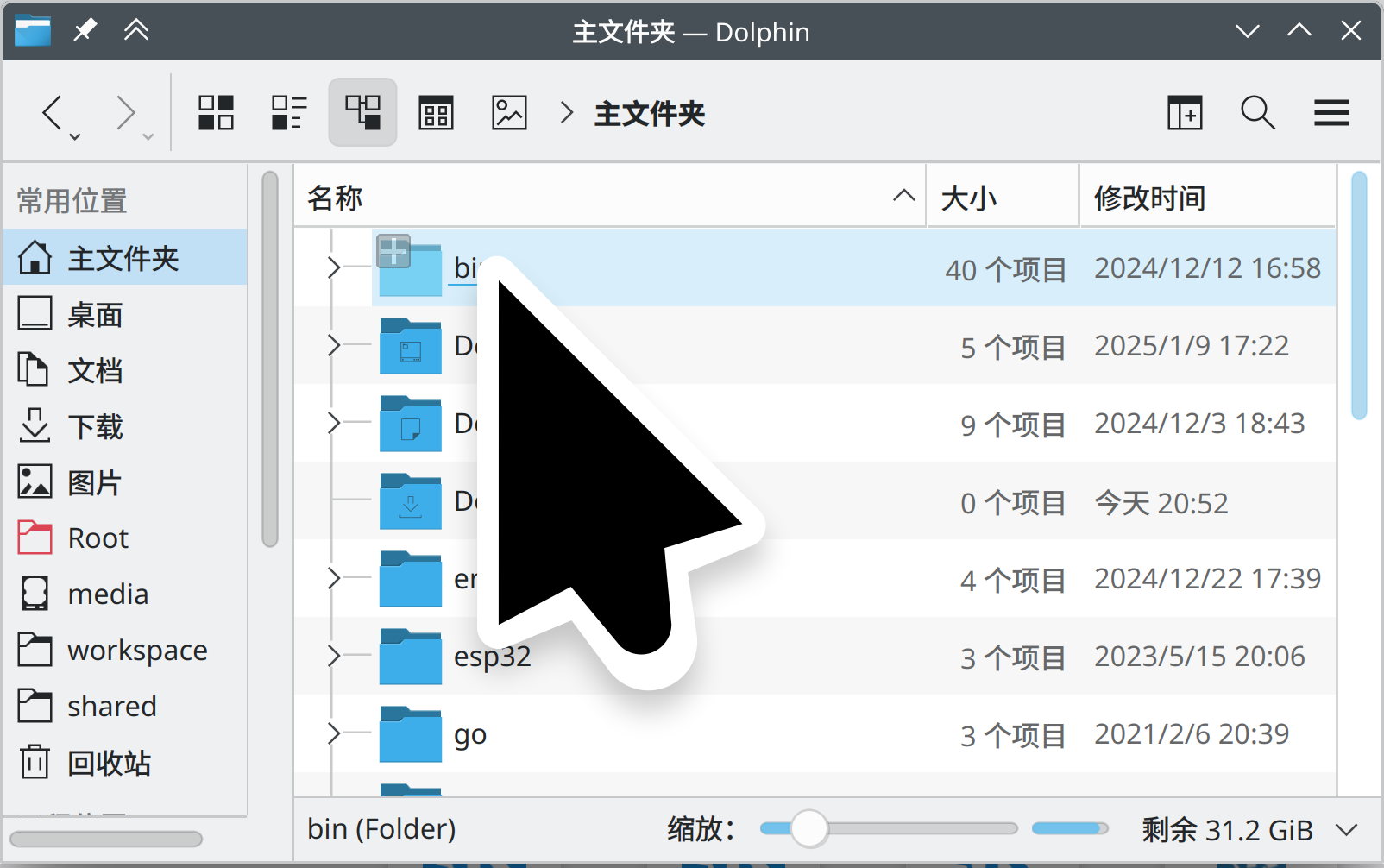
But we can do it manually with kcursorgen. Take Breeze for example:
Step 1: Make a copy of the theme
First, copy the cursor theme to your home directory. And let's change the directory name, so the original one is not overriden:
Then open ~/.local/share/icons/breeze_cursors.my/index.theme in the editor. Change the name in Name[_insert your locale_]= so you can tell it from the original in the cursor settings.
Step 2: Regenerate the XCursor files
For example, if we want a size 36 cursor, and the display scale is 250%:
Some Wayland apps don't support fractional scaling, so they will round the scale up. So we need to include both 2.5 and 3 in the scale list.
The above command generates XCursor at size 36, 90 and 108. Note that the max size of the original Breeze theme is 72, so this is something not possible with the original theme.
(kcursorgen also adds paddings when necessary, to satisfy alignment requirements of some apps / toolkits. E.g., GTK3 requires cursor image sizes to be multiple of 3 when the display scale is 3. So please use --sizes=36 --scales=1,2.5,3, not --sizes=36,90,108 --scales=1, because only the former would consider alignments.)
Then you can go to systemsettings - cursor themes, select your new theme, and choose size 36 in the dropdown.
(Yes, you can have HUGE cursors without shaking. Size 240.)
Trick 2: Workaround for the huge cursor problem in GTK4
As explained before, Breeze theme triggers a bug in GTK4 when global scaling is used, resulting in huge cursors. It's because Breeze's "nominal size" (24) is different from the image size (32).
We can work around this problem by changing the nominal size to 32.
Step 1 is same as above. Then we modify the metadata:
cd ~/.local/share/icons/breeze_cursors.my
find cursors_scalable/ -name 'metadata.json' -exec sed -i 's/"nominal_size": 24/"nominal_size": 32/g''{}'\;rm -r cursors/
kcursorgen --svg-theme-to-xcursor --svg-dir=cursors_scalable --xcursor-dir=cursors --sizes=32 --scales=1,1.5,2,2.5,3
Then you can go to systemsettings - cursor themes, select your new theme, and choose size 32 in the dropdown. Cursors in GTK4 apps should be fixed now.
Extra idea: (For distro maintainers) reduce cursor theme package size to 1/10
It might be possible to only package the index.theme file and cursors_scalable directory for the Breeze cursor theme (and other SVG cursors themes), then in an postinstall script, use kcursorgen to generate the cursors directory on the user's machine.
This would greatly reduce the package size. And also you can generate more sizes without worrying about blown package size.
But the fact that kcursorgen is in the breeze package might make some dependency problems. I have an standalone Python script that does the same. (But it requires Python and PySide6.)
The Amarok Development Squad is happy to announce the immediate availability of Amarok 3.2.1, the first bugfix release for Amarok 3.2 "Punkadiddle"!
3.2.1 features fixes for some small UI bugs, improvements for file transfers to MTP devices, and some compilation fixes for different combinations of Qt6 versions and compilers, enabling easier testing of Qt6 builds.
Additionally, it is now theoretically possible to enable last.fm and gpodder.net support in a Qt6 build. However, this requires Qt6 support in liblastfm and libmygpo-qt; a functionality that
is not yet included in the most recent released versions of the libraries.
Changes since 3.2.0
CHANGES:
Support gpodder and lastfm on Qt6 builds
Limit maximum current track font size more when context view is narrow
BUGFIXES:
Fix displaying settings button for Internet services
Enable Wikipedia context applet on Qt6 builds
Don't crash when copying multiple files to MTP device (BR 467616)
Avoid unnecessarily flooding MTP devices with storage capacity queries
Compilation fixes for various compiler + Qt6 version combinations
Getting Amarok
In addition to source code, Amarok is available for installation from many distributions' package
repositories, which are likely to get updated to 3.2.1 soon, as well as
the flatpak available on flathub.
A while ago a colleague of mine asked about our crash infrastructure in Plasma
and whether I could give some overview on it. This seems very useful to
others as well, I thought. Here I am, telling you all about it!
Our crash infrastructure is comprised of a number of different components.
KCrash: a KDE Framework performing crash interception and prepartion for handover to…
coredumpd: a systemd component performing process core collection and handover to…
Sentry: a web service and UI for tracing and presenting crashes for developers
We already looked at KCrash, coredumpd, and DrKonqi. This week it’s time to look at the final piece of the puzzle — Sentry.
Sentry
Sentry is the service we have on the developer side of a crash to manage incoming reports.
As we’ve learned in the DrKonqi post, a Sentry-specific trace created by the preamble is eventually sent off to our Sentry server. In Sentry, yet more processing happens!
Symbolication
If the user hasn’t explicitly opted into it, there usually aren’t debug symbols available on the user system. This would ordinarily render backtraces useless since they are just a bunch of memory addresses without names or references to our source code.
One of the reasons we adopted Sentry is because it can
fill in the gaps through a process called symbolication. For symbolication it essentially needs to know all the loaded libraries and can then fetch the relevant debug symbols via the various debuginfod instances out there. Once it has the debug symbols it can resolve that the address 0x2343244 is really the function int main(int argc, char **argv)
Fingerprinting
When a trace has been symbolicated it’s ready for fingerprinting. This tries to merge together the same
crash appearing in different submission into one single sentry event. Generally speaking if two submissions have the same trace frames, they are considered the same crash and merged into one event (in practice the rules are a bit more complicated).
Result
Eventually the crash event appears for us to fix.
In a future blog post, I’ll also give a more detailed guide on how to use Sentry to its full potential.


 ipwizard


 @ivan:kde.org